Blog
Container Sizes Explained 20ft vs 40ft vs High Cube

Container Sizes Explained: 20ft vs 40ft vs High Cube — What You Need to Know First
If you've started researching shipping containers in Canada and found yourself staring at a wall of numbers container sizes explained 20ft vs 40ft vs high cube — you're not alone. Most people walk into this with one question and walk out with ten. That's completely normal. Whether you're a contractor in British Columbia, a small business owner in Ontario, or a homeowner in Alberta looking for extra storage, the size you choose will affect your budget, your site plan, and your long-term flexibility. This guide breaks it all down simply, honestly, and with the kind of detail that actually helps you make a decision. No fluff. No guessing. Just what you need to know first.
Comparing 20ft vs 40ft vs High Cube Container Sizes
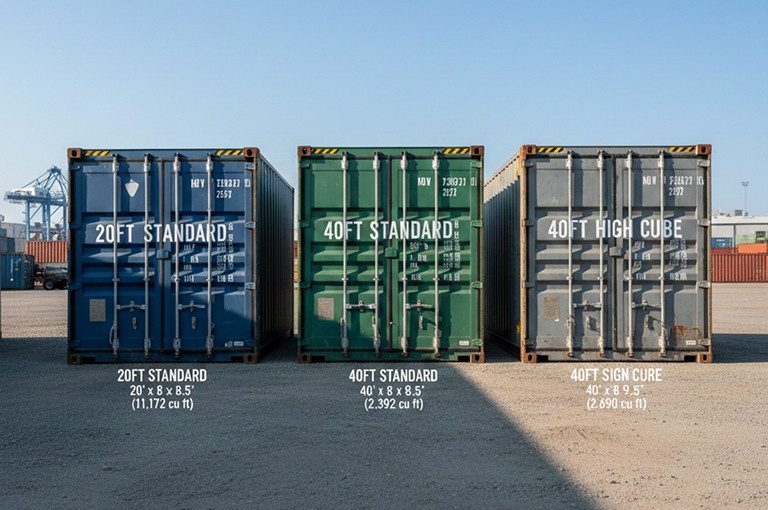
Before you browse any product listings on our site, it helps to understand what you're actually comparing. The three most common sizes you'll encounter in Canada are the 20-foot standard, the 40-foot standard, and the 40-foot high cube. Each one serves a different purpose, and none of them is universally "better" than the other.
Here's a quick visual breakdown:
| Container Type | External Length | External Width | External Height | Internal Volume (approx.) |
|---|---|---|---|---|
| 20ft Standard | 6.06 m (20 ft) | 2.44 m (8 ft) | 2.59 m (8.5 ft) | ~33 m³ |
| 40ft Standard | 12.19 m (40 ft) | 2.44 m (8 ft) | 2.59 m (8.5 ft) | ~67 m³ |
| 40ft High Cube | 12.19 m (40 ft) | 2.44 m (8 ft) | 2.90 m (9.5 ft) | ~76 m³ |
The dimension of a 20ft container sits at approximately 6.06 m long × 2.44 m wide × 2.59 m tall externally, with an internal height of around 2.39 m. If you need the length and width of a 20ft container in feet, that's 20 ft × 8 ft — a footprint that fits comfortably on most residential lots across Canada.
The 40ft high cube container dimensions in cm come in at roughly 1,219 cm long × 244 cm wide × 290 cm tall, and in millimetres (40ft high cube container dimensions in mm), that's 12,192 mm × 2,438 mm × 2,896 mm. That extra 30 cm of height compared to the standard 40ft might not sound like much, but it makes a real difference when you're storing tall equipment, doing a container conversion, or stacking inventory.
Key Factors to Consider Before Choosing a Container Size
Choosing a container isn't just about square footage. Before you contact our team or finalize your order, run through these factors:
1. What are you using it for? Storage, shipping, a site office, a retail pop-up, a farm equipment shelter? Each use case draws you toward a different size. Agricultural operations across Canada often need the extra length of a 40ft for machinery. Retailers prefer the 20ft for its mobility and easier permit approvals in urban zones.
2. Where is it going? Can your property or job site accommodate the 40 feet container size in meters (12.19 m)? Or does your access lane, municipal zoning, or tight footprint push you toward a 20ft? In many parts of Canada, a 20ft can be delivered and positioned in spaces where a 40ft simply won't fit.
3. Do you need height clearance? If you're working with tall pallets, industrial equipment, or planning a container conversion with insulation and interior framing, the high cube's extra headroom is worth the modest price premium.
4. How long is your timeline? Short-term renters and event organizers in Canada typically lean toward 20ft containers for the flexibility and lower upfront cost. Industrial and logistics companies managing long-term inventory almost always go 40ft or 40ft high cube.
Best Shipping Container Size for Moving and Storage
For moving and residential storage in Canada, the 20ft container is the most practical choice for most households. It holds the contents of a 3–4 bedroom home comfortably, and it's far easier to position in a driveway or on a residential street. If you're moving a large estate or combining relocation with business inventory, a 40ft gives you room to consolidate everything in one unit.
For on-site construction storage — tools, materials, equipment — both the 20ft and 40ft are workhorses. The 20ft is lighter and easier to reposition as a build progresses. The 40ft keeps more on-site without multiple units cluttering your build area.
Explore our storage container options to compare what's currently available across Canada.
Which Container Size Is More Cost-Effective?
This is the question everyone asks, and the honest answer is: it depends on your usage density.
A 20ft container in Canada will cost less upfront — both to purchase and to deliver. But if you fill it to capacity and need a second unit, you've often spent more than a single 40ft would have cost. The 40ft is typically better value per cubic metre of space.
The 40ft high cube edges out the standard 40ft in cost-effectiveness when height matters. If you're storing tall furniture, vertical racking systems, or doing any kind of conversion work, paying a little more for the high cube means you won't have to compromise on how you use the space.
For short-term needs event staging, pop-up retail, seasonal farm storage across Canada a 20ft rental is almost always the most budget-friendly path. For long-term or permanent installations, run the full cost calculation including delivery, site prep, and any permits required in your municipality.
Shipping Container Height and Width Differences
The width of every standard ISO container — 20ft, 40ft, and high cube — is 2.44 m (8 ft) externally. This is consistent across types, which matters for things like site planning, permit submissions, and side-by-side placement.
Where the types diverge is in height:
- Standard 20ft and 40ft: External height of 2.59 m (8 ft 6 in), internal height of approximately 2.39 m (7 ft 10 in)
- 40ft High Cube: External height of 2.90 m (9 ft 6 in), internal height of approximately 2.70 m (8 ft 10 in)
Shipping container sizes in meters are fairly standardized globally, which is why Canadian buyers can source units from international shipping lines and find consistent dimensions regardless of origin country. Whether you're buying new or used in Canada, these ISO standards hold.
How Container Dimensions Affect Storage Capacity
Volume is where the differences really stack up. The 20ft container gives you approximately 33 cubic metres of usable space. The 40ft jumps to roughly 67 m³ — almost exactly double. The 40ft high cube takes that to approximately 76 m³, thanks to the added height.
For product listings and inventory planning, this distinction is critical. Retailers and e-commerce operators in Canada storing large volumes of goods need to calculate how many pallets or shelving units will actually fit. Standard pallet configuration in a 20ft allows for roughly 10–11 standard pallets in a single row. A 40ft can hold 20–21 pallets. The high cube adds vertical stacking potential on top of that.
For farmers, the capacity question often comes down to bulk materials — grain bags, fertilizer, equipment parts. A 40ft container stores significantly more while still being a durable, weatherproof, and secure unit. For construction companies managing tools and materials across multiple sites in Canada, a pair of 20ft containers can sometimes be more operationally flexible than a single 40ft, depending on how frequently your needs change.
Visual storytelling helps here: picture the 20ft as roughly the size of a large garden shed, the 40ft as close to a standard semi-trailer, and the high cube as that same trailer with a raised roof. That scale makes the decision much more tangible.
How to Select the Right Shipping Container Size
Here's a simple framework that works whether you're a first-time buyer or managing a fleet of containers across Canada:
Step 1 — Define your primary use. Storage, shipping, conversion, or temporary use? Each draws you toward a different size category.
Step 2 — Measure your available space. Know your footprint before you commit. A 40 feet container size in feet is 40 ft × 8 ft. In meters, that's 12.19 m × 2.44 m. That's your non-negotiable site requirement.
Step 3 — Estimate your volume needs. Add up what you're storing or shipping. Use the cubic metre figures above. Leave 20–30% buffer for practical usability — things are never perfectly stackable in real life.
Step 4 — Factor in weight. The weight of a 20ft HC container (high cube) is approximately 2,400 kg (tare weight). Maximum payload for a 20ft standard is around 28,230 kg. The maximum weight of a 40ft HC container is typically around 26,680 kg payload — though exact figures vary by manufacturer. When asking how many tons are in a 40ft container, the max gross weight is generally 30,480 kg (30.48 metric tonnes).
Step 5 — Consider customization. Need roll-up doors, vents, shelving, windows, or insulation? These customization options affect which base size works best for your project. High cube containers offer the most room for interior modifications.
Step 6 — Think about long-term flexibility. Containers can be relocated, which is part of their appeal. If your operation moves or grows, a 20ft is easier to transport. If you're setting a permanent footprint, the 40ft high cube tends to offer the most long-term value in Canada.
Actionable Specifications at a Glance
For quick reference when comparing product listings or planning your order:
20ft Standard Container
- External: 6.06 m L × 2.44 m W × 2.59 m H
- Internal: ~5.90 m L × 2.35 m W × 2.39 m H
- Tare weight: ~2,200 kg
- Max payload: ~28,230 kg
- Volume: ~33 m³
40ft Standard Container
- External: 12.19 m L × 2.44 m W × 2.59 m H
- Internal: ~12.03 m L × 2.35 m W × 2.39 m H
- Tare weight: ~3,750 kg
- Max payload: ~28,750 kg
- Volume: ~67 m³
40ft High Cube Container
- External: 12.19 m L × 2.44 m W × 2.90 m H
- Internal: ~12.03 m L × 2.35 m W × 2.70 m H
- 40ft high cube container dimensions in cm: 1,219 cm × 244 cm × 290 cm
- 40ft high cube container dimensions in mm: 12,192 mm × 2,438 mm × 2,896 mm
- Tare weight: ~3,900 kg
- Max payload: ~26,680 kg
- Volume: ~76 m³
These are standard ISO specifications. Actual figures can vary slightly between manufacturers and container age, especially for used units sourced in Canada. Always verify with the supplier.
Sustainability and Durability
One thing worth mentioning — and something that matters more every year in Canada — is the environmental angle. Repurposing shipping containers that have completed their international voyage is a genuinely sustainable choice. You're giving a robust steel structure a second (or third) life rather than manufacturing new materials.
In terms of durability and security, all three container types are built from Corten steel — a weathering steel designed to form a protective rust patina rather than corrode through. With basic maintenance, a container in Canada can last 25 years or more. They're lockable, stackable, and resistant to wind, rain, snow, and pests — no small thing when you're dealing with Canadian winters.
Whether you're in a mild coastal climate or a harsh prairie environment, standard container specifications are built to handle it. Check our blog for more on maintenance, site prep, and what to look for when buying used.
Frequently Asked Questions
What is the size of a 10ft container? A 10ft container isn't an ISO standard size, but it's sometimes available as a half-cut unit. Typical external dimensions are approximately 3.0 m L × 2.44 m W × 2.59 m H. Availability varies across Canada.
What are standard container sizes explained — 20ft and 40ft vs high cube? The standard 20ft and 40ft have the same height (2.59 m), while the high cube adds 30 cm of additional vertical space. The width is identical across all three types at 2.44 m.
What are shipping container sizes in meters for a 40ft? The 40 feet container size in meters is 12.19 m long × 2.44 m wide × 2.59 m tall (standard) or 2.90 m tall (high cube).
How many tons are in a 40ft container (maximum)? The maximum gross weight of a 40ft container is typically 30.48 metric tonnes. The tare (empty) weight is around 3.75–3.9 tonnes, leaving roughly 26–27 tonnes of payload capacity.
Is the high cube worth it for residential use? Often, yes — especially for conversions. The extra headroom makes the interior feel significantly more livable or workable. If you're building a home office, studio, or guest suite from a container, the high cube is the smarter starting point.
Can I get a container delivered anywhere in Canada? Maple Containers serves customers across Canada. Delivery logistics depend on your location and site access get in touch and we'll work through the specifics with you.
Final Thoughts
Understanding container sizes explained — 20ft vs 40ft vs high cube — is really just the beginning. The size is the framework. What you do inside it, how you customize it, and how it fits your specific site and use case in Canada is where the real decision-making happens.
If you're still unsure which size makes the most sense, browse our container inventory or reach out directly. We're happy to walk through your requirements, provide a quote, and help you find the right fit without pushing you toward something that doesn't match your actual needs. That's how it should work.
Published by Maple Containers — Canada's trusted source for new, used, and modified shipping containers.